A garage door opener universal remote can replace many lost, damaged, or extra handheld remotes. It cannot repair a broken opener, door, sensor, spring, or cable. Compatibility depends on the brand, model, code system, and programming method. Checking these details first helps avoid wasted time and unsafe guesses.
A spare remote may seem simple until it will not pair. The problem could be a weak battery, an unsupported opener, or a door fault. Knowing what the device can and cannot do makes the next step easier for homeowners and property owners in Faribault.
Table of Contents
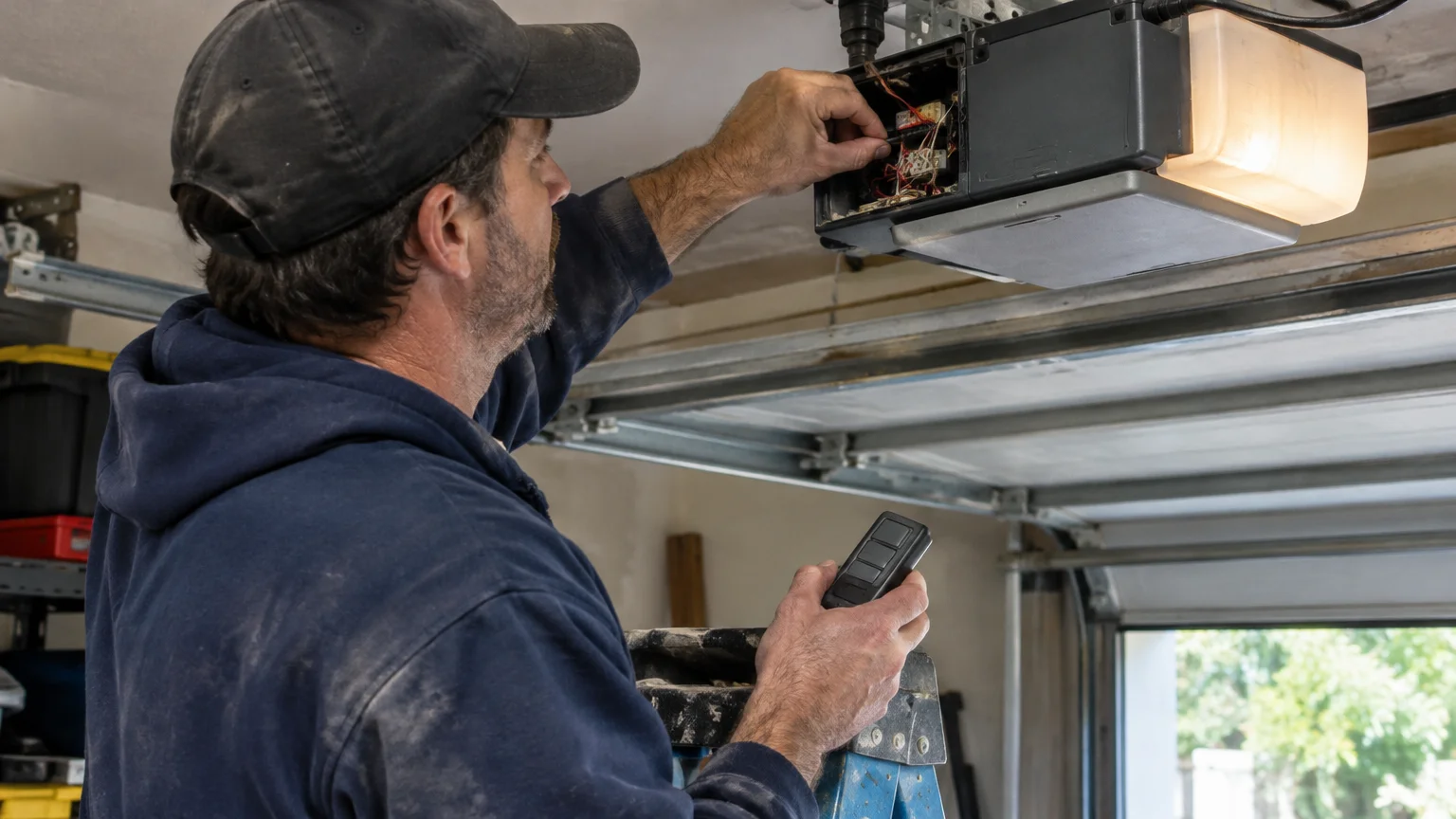
- What is a garage door opener universal remote?
- What can a universal remote replace?
- What can a universal remote not replace?
- How do you know if a universal remote is compatible?
- How do you program a universal garage door remote?
- What should you do when a universal remote does not work?
- When should you choose a universal remote or call a garage door professional?
- Key takeaways
- Frequently Asked Questions
- Conclusion
What is a garage door opener universal remote?
A garage door opener universal remote is a handheld control for selected opener brands and systems. It sends a wireless signal to the opener motor. When the signal matches the stored code, the door can open or close.
The word universal does not mean the remote works with every opener. Each product supports certain brands, models, frequencies, or code systems. The package and instructions should explain these limits before you buy.
How universal remotes differ from original equipment remotes
An original equipment remote comes from the opener maker or one opener family. It often supports more of that brand’s features. A universal remote is made to work with several brands or systems.
A universal model can help when the original remote is lost or no longer sold. It may have fewer buttons, though. A wall control, light button, vacation lock, or smart feature may not work through it. The basic open and close command is usually the main feature.
Faribault Garage Door Repair can help Faribault homeowners compare a replacement remote with the opener already installed. The opener label matters more than the shape of the old remote.
Which garage door systems universal remotes can control
Many universal remotes work with common home opener brands. Some control more than one door. Others control only one opener. Compatibility can also depend on the opener’s age and security system.
Older systems may use fixed code switches. Newer systems often use rolling codes. A rolling code changes after each accepted signal. The remote must support the same type of system before pairing can work.
What can a universal remote replace?
A universal remote can replace many handheld controls used to open and close a garage door. It may replace a lost remote, a damaged one, or an extra control for another driver. It may not replace every feature of the original device.
Check the opener brand and model before buying. Then compare them with the remote’s support list. Two remotes can look alike and still use different signals.
Replacing a lost, damaged, or extra handheld remote
A universal remote is often useful when the original control is missing. It can also help when the case is cracked, the buttons are worn, or the remote works only nearby.
A weak battery can cause poor range. Replacing the battery may solve the problem without replacing the remote. Check the battery area for corrosion, loose contacts, or damage before buying anything else.
If a remote was lost, remove it from the opener’s memory when possible. This helps prevent someone else from using it. The owner’s manual should explain how to erase old controls and pair the ones that remain.
Using one remote for multiple garage doors
Some universal remotes control more than one opener. Each button may pair with a separate door. The remote must support the brands and code systems used by both openers.
Test each door from a safe place. The door should move smoothly, and its safety system should stop or reverse when it sees an obstruction. A remote cannot correct a door that binds, falls, or moves unevenly.
Labels can prevent confusion when one remote controls several doors. This helps homes with attached garages, workshops, or rental spaces. Businesses should also remove access for former workers and lost controls.
What can a universal remote not replace?
A universal remote cannot replace the opener motor, wall control, photo-eye sensors, wiring, springs, cables, or other mechanical parts. It sends a command, but it does not create the power or movement needed to lift the door.
This matters when a new remote does not work. The problem may not be the remote. A dead opener, blocked sensor, bad circuit board, or broken spring needs a different response.
When a remote cannot overcome an incompatible opener
A universal remote cannot pair with an opener that uses an unsupported brand, frequency, or security system. Some older units have few replacement choices. Some newer units need a certain remote family or receiver.
The opener label and manual provide useful clues. The remote package may list supported model numbers. If the information is unclear, a professional can identify the opener before another device is purchased.
A smart garage door opener adds another layer. It may use an app, wireless hub, or network connection. A handheld universal remote may open the door while leaving smart features unavailable.
Why universal remotes do not fix opener or door problems
A remote cannot fix a door that is off its tracks or a motor that only hums. It cannot repair broken lift cables, a damaged wall button, or a bad garage door spring. It also cannot make a door safe when springs or brackets are failing.
The same applies to panel damage. Questions about how to repair a garage door panel concern the door itself, not the remote. Panel work can affect balance, alignment, and safe movement, so it should be assessed separately.
If the opener runs but the door does not move, the trolley, drive system, or door connection may be at fault. Garage Door Opener Repair can address opener faults, while Garage Door Off Track Repair addresses alignment problems. These are not remote programming issues.
How do you know if a universal remote is compatible?
Compatibility means the remote matches the opener brand, model, code system, and programming method. The remote should list the opener family or model range. Guessing from appearance alone is not reliable.
The opener label is often on the motor housing. The old remote may also show a brand or model number. Photos of both items can help a professional find a better match.
Checking opener brands, models, frequencies, and programming methods
Start with the brand and model printed on the opener. Then check the universal remote instructions for that information. Some products list broad brand support. Others list only certain model groups.
Frequency is the radio signal range used by the remote and opener. A remote using a different frequency may not pair, even when the brand name matches.
Programming methods also vary. Some systems learn a remote through a button on the motor unit. Others use code switches, a keypad sequence, or a separate receiver. The instructions should explain which method applies.
Understanding rolling codes, dip switches, and security systems
A rolling code system changes the accepted code after a successful command. This helps limit the use of an old signal. The remote and opener must share a compatible rolling-code system.
Dip switches are small physical switches used to set a fixed code on some older equipment. The remote and receiver need matching settings. Since these switches can be easy to misread, follow the manual.
Modern security systems may use encrypted or brand-specific communication. A universal remote may support some systems but not others. If the opener has a smart hub or unusual receiver, professional help can prevent repeated failed pairing attempts.
How do you program a universal garage door remote?
Programming a universal garage door remote usually means placing the opener and remote into learning mode. The remote then sends the correct signal. The exact order changes by brand and model, so the product instructions should guide the process.
Stay clear of the moving door. Keep children and vehicles away while testing. Programming is not a reason to touch springs, cables, brackets, or other parts under tension.
Preparing the opener and remote before programming
Install the correct battery and remove any protective tab. Make sure the opener has power and that the wall control works. Clear nearby clutter so the door can be watched from a safe place.
Keep the opener manual nearby. Record which button will control the door, especially if one remote will operate more than one opener.
If the opener has no power, the wall control is dead, or the unit shows damage, programming may not solve the issue. Garage Door Opener Repair may be needed before a replacement remote can be tested.
Common programming steps and signs of successful pairing
Most systems use a learn or program button on the opener. The remote is then placed in pairing mode, and a selected button is pressed as directed. Some systems need a confirmation press or short wait before testing.
The instructions may differ for fixed-code and rolling-code openers. Do not guess at button combinations when the manual is unclear. A wrong sequence may erase other remotes or change stored settings.
Successful pairing may make the opener light flash or the unit click. The door may also respond to the chosen button. Test it from a clear place. If it moves partway, reverses, or makes a harsh sound, the opener or door may be at fault.
What should you do when a universal remote does not work?
When a universal remote does not work, begin with safe checks. Confirm the battery, compatibility, distance, and programming mode. If those checks fail, the opener or door may need inspection.
A remote problem is often simple, but repeated attempts can hide a larger fault. Stop testing if the door acts in an unsafe way.
Troubleshooting batteries, range, buttons, and memory
Replace the battery with the type listed in the instructions. Check that it faces the right way and that the contacts are clean. A damaged button or cracked circuit board may prevent the remote from sending a signal.
Test the remote within its normal range while facing the opener. If it works only nearby, interference, a weak battery, or an antenna problem may be involved. The remote may also be paired with a different opener.
If the opener memory is full or the remote was programmed incorrectly, it may need to be erased and paired again. The manual should explain this process. Erasing memory can remove other working remotes, so approved controls may need to be paired again.
When to inspect the opener, sensors, wiring, or antenna
The opener needs attention when the wall button also fails, the motor is silent, or the light flashes without movement. Photo-eye sensors should face each other and stay free of dirt or objects. A blocked or misaligned sensor can stop the door from closing.
Loose wiring, a damaged antenna, or a failed circuit board can affect remote signals. These parts should be checked by someone trained to work on openers. Do not open the motor housing casually.
A door that is heavy, crooked, noisy, or stuck needs more than a new remote. Garage Door Maintenance can help find wear early, while Garage Door Cable Repair may be needed when a cable is loose or damaged. Cable and spring work can release stored force and should not be attempted as home repairs.
When should you choose a universal remote or call a garage door professional?
A universal remote makes sense when the opener works normally and the problem is limited to a lost, damaged, or extra handheld control. A professional is safer when the opener, door, sensors, wiring, or lifting parts show trouble.
The choice becomes easier when you separate access control from mechanical repair. A remote manages a signal. It does not make an unsafe door safe.
Situations where a universal remote is a practical solution
A universal remote may fit when:
- The opener responds normally to its wall control.
- The old remote is lost, cracked, or worn out.
- The opener brand and model appear on the support list.
- The owner needs an extra control for a household member.
- The remote will operate supported doors.
Homeowners can safely handle battery changes, label checks, cleaning, and careful testing. They do not need a professional for these simple tasks when the door works normally. They should not work on springs, cables, bottom brackets, or other parts under tension.
Faribault Garage Door Repair helps property owners sort out remote questions when the right device is unclear. The company serves homes and businesses in Faribault, including nearby Medford, Morristown, Northfield, and Lonsdale.
Safety concerns and repair issues that need professional help
Professional help is needed when a door falls, binds, sits crooked, or will not stay open. It is also needed when springs, lift cables, bottom brackets, or tracks appear damaged. These parts can move with great force and cause severe injury.
A professional can inspect the full system and explain whether repair, replacement, or opener installation is suitable. Do not remove springs, adjust spring tension, lift cables, or bottom brackets without proper training and tools.
For urgent access or security concerns, Garage Door Installation or Garage Door Opener Repair may be the right service path. The work needed depends on the part, opener type, access, damage, and urgency. The final cost is confirmed on a quote before approved work.
Key takeaways
- A universal remote replaces many compatible handheld remotes, not every control.
- Brand, model, frequency, code type, and programming method affect compatibility.
- A remote cannot repair a dead opener, broken spring, damaged cable, bad sensor, or off-track door.
- Homeowners can safely check batteries, labels, buttons, range, and basic cleanliness.
- Spring, cable, bracket, wiring, and mechanical door repairs require trained help.
Frequently Asked Questions
Can any universal remote work with any garage door opener?
No. A universal remote works only with brands, models, frequencies, and code systems it supports. Universal means broader compatibility, not complete compatibility. Check the opener label and remote instructions before buying. If the model is unclear, a garage door professional can help find a suitable replacement.
Will a universal remote work with an older opener?
It may, but older openers can use fixed codes, unusual frequencies, or discontinued receivers. Some universal remotes support these systems, while others work only with newer rolling-code openers. The opener model and receiver type matter more than the remote’s appearance. A replacement receiver may be needed.
Can a universal remote fix a garage door that will not open?
No. A new remote cannot fix a broken spring, dead motor, failed sensor, damaged wiring, or off-track door. First check whether the wall control works and whether the opener has power. If the door is heavy, crooked, or unsafe, stop testing and arrange an inspection.
How many garage doors can one universal remote control?
That depends on the remote model. Some have buttons for more than one opener, while others operate only one door. Each opener must be compatible. After pairing, test every button from a safe position and label them if the property has several doors.
Why does the remote work only from a short distance?
Short range can result from a weak battery, dirty contacts, a damaged button, radio interference, or an antenna problem. Replace the battery first and test near the opener. If the wall control also acts strangely, the opener may need inspection instead of another remote.
Conclusion
A garage door opener universal remote can restore access when the opener works and the replacement device is compatible. It cannot repair the door, motor, sensors, springs, cables, or wiring. Careful model checks and safe testing help owners choose the right solution.
Faribault Garage Door Repair can help property owners when a remote problem may point to a larger opener or door fault. Contact us today for urgent help choosing the next safe step.